Skip to content
Vidueiro
Manuel Antonio Cuevas Vidueiro

Biography

Manuel Antonio Cuevas Vidueiro

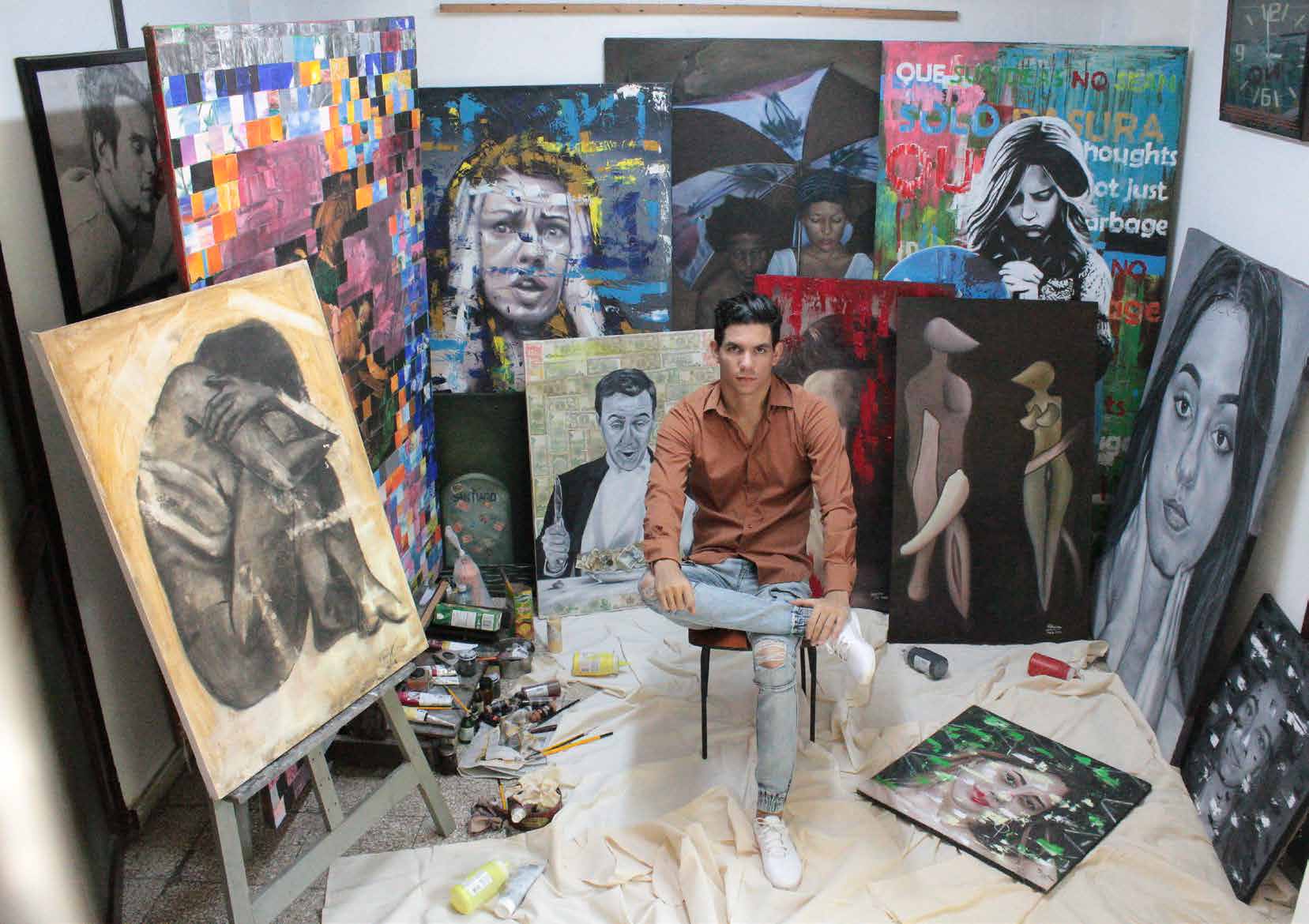
Manuel Antonio Cuevas Vidueiro (Santiago de Cuba, 1997) is a visual artist whose practice revolves around identity, intimacy, memory and forms of self-representation. Self-taught, since 2017 he has built a body of research that starts from drawing and painting and expands into mixed media, collage, photography, the object and installation.

Between 2019 and 2022 he presented solo and group exhibitions in Santiago de Cuba and other towns, and in 2019 he received an award at the International Caribbean Salon. Since 2024 he has worked in Spain, where his exhibitions include “Segmentos” (Casa Parada Museum, Tarancón, 2024) and “Punzadas del ser” (Alzacopas Gallery, Madrid, 2024).

His current research is Self-portraitism, a concept he coined to understand the self-portrait as a process and not only as a physical depiction.

Milestones

2017
First group exhibitions and Religious Art Salon.
2019
First solo exhibition: “The skin I inhabit”.
2019
Award of the International Caribbean Salon.
2020
14th International Mural Painting Meeting INTERNOS.
2022
Solo exhibition “Airplane mode”, Arte Soy Gallery.
2023
The Origin period closes with “The intermediary”, a self-portrait.
2024
“Segmentos”, Casa Parada Museum, Tarancón.
2024
“Punzadas del ser”, Alzacopas Gallery, Madrid.
2025
“Desde la Ansiedad”, an action with self-portraits recorded by drone.
2026
“Presencias Cruzadas”, Museum of Contemporary Art, Tarancón.
Hoy
The Witness: 80 of a thousand self-portraits, in Madrid.

Portraying myself: notes for a biography in progress

Talking about myself is inevitably talking about the places that inhabit me. I cannot conceive of my path —personal or creative— apart from the surroundings that shaped me. I come from places saturated with stimuli: smells that mix, noises that compete, human presences that overlap without rest. The sea, near or imagined, has always been there as a living border; the city, with its uneven rhythms and everyday wear, was my first mirror.

I understood early on that the face is not just a surface but a territory. My hands —stained with work, attempts and mistakes— have witnessed a process that never followed a straight line. I trained myself through self-teaching, insistent observation and the need to practise again and again, combining formal studies with workshops, mentoring and lessons that came more from human exchange than from established programmes. Each step was a form of slow healing, like the processes that need time and patience to reach their right point.

I was never interested in comfortable formats or predictable solutions. Large format soon appeared as an inevitable, almost physical challenge, where the body enters into direct dialogue with the work. In that confrontation a constant emerged: the face. Not as a closed identity, but as a battlefield. Each image was, and still is, an attempt to understand my own states, reactions, fractures and projections as an individual within a complex and often hostile social reality.

Over the years my work began to circulate in solo and group exhibitions, places I did not experience as goals but as stations in transit. Each show marked a moment in my emotional biography: the skin as a border, waiting as conflict, a gaze turned upwards in search of meaning, silence —imposed or chosen— as a defence. Some of those experiences exceeded other people’s expectations; for me, all of them were necessary.

I have taken part as a maker, as a juror and as a critical observer of the art scene around me. Even so, I have never stopped feeling in process. At an age when crises, ruptures and redefinitions tend to gather, I understood that my work could not be separated from an ethical stance: taking on creation as an exercise of responsibility, social questioning and intimate resistance.

From that stance comes what I have called Self-portraitism. Not as a closed aesthetic category, nor as a narcissistic repetition of the self, but as a critical tool. Portraying myself means examining myself, taking myself apart and putting myself back together through my bonds with others, my uprootings, my misfits and my aspirations. I am not interested in empty existentialism; I am interested in the human being crossed by their time: vulnerable, unfinished, contradictory.

My work is, in essence, a gallery of states. Faces that do not seek to please, but to question. Surroundings charged with anguish and, at the same time, with a stubborn hope. In every image beats the need to restore ourselves, to save something of ourselves before the mirror stops giving back a recognisable gaze. Perhaps that is why I keep working: because I have not yet finished finding my face, and because I know that, in that search, others discover themselves too.
Vidueiro

«I feel a strong need to bring what I think to any surface, perhaps that’s what makes me an artist»

Vidueiro

«Art serves as a refuge for us when we need to escape from society»

Vidueiro

Critical text

Vidueiro. An alchemy for color

Manuel Antonio Cuevas Vidueiro wields the skin of a woman as his shield. It is indeed the canvas upon which the spectrum of spirituality rests, where he imprints the brushstrokes of the real history we live, made possible only by that entity named WOMAN.

Indeed, woman is the icon that enables the existence of an artist like Manuel Antonio Cuevas Vidueiro... Could there possibly be any creative exception on this planet Earth? But let it be known, the creator intertwines this preference dynamically with the social context. And this, precisely, is Manuel’s merit: an organic ethical and aesthetic principle—it is not merely woman for the sake of woman.

Cuevas Vidueiro’s work is like the literary technique of the Chinese box or the hidden compartments of a magician’s hat... Each visual detail contains an abundance of conceptual depth. The artist, for the better, suffers from a profound necessity when he places woman at the center of his universe in his artistic endeavors. She becomes a being of avid consciousness and piercing perseverance, naturally inclined to illuminate the dark corners of the human spirit, revealing the unsuspected geography of her profound thoughts on renewal and revitalization of life’s actions.

The creator remains loyal to his codes, continually displaying them, yet without formal or conceptual exuberance, without imposing anything upon the viewer who follows his work.

Hyperrealism may find its breath and place in Manuel’s artistic approach. It is merely a matter of skill and substrates, and therein lie his virtues.

The artist does not obsess over social conflicts, but rather examines them from the realm of intimacy. For him, the essential arises from the transcendence of the free human being, from the chronology of life, from ascent and existential revalidation, guided by the dynamism imposed by time and space.

Within the canvases of Manuel Antonio Cuevas Vidueiro, pages of psychology and sociology emerge, entwined with the cultural anthropology that sets his brush apart. This is his own life story. As the art historian, curator, and essayist Luisa María Ramírez Moreira put it, this artist carries “a philosophy founded on the cry of silence.” The artist surpasses the purely physical and corporeal aspects of human beings. The images come forth to remind us that we are part of their dissected conflicts and that we must set free the freedom that lies within the shadows of our mundane everyday lives.

The creator propels us towards his visual antitheses, and we come to realize that our hands are within our souls: Manuel Antonio Cuevas Vidueiro, or the eloquence of his shared expressiveness, because by delving into his creative world, the viewer is compelled to assume the other perspective: “to stand before the easel and take up the brush”.

Preciousness is present even in the drama of humanity, especially in the uprooting of man, in the loss of beliefs and values. These are the certain coordinates of this young artist. Thus, for Vidueiro, it is not a matter of migrating geographically or economically; everything translates into the true emigration of the soul and its convincing fruition on the other shore. The tears falling on a suitcase are captured; a plane awaits. What is also admirable is his exploration of Vidueiro’s color tones to conceptualize his existentialism, particularly in appreciating his blacks and sepia in decisive visual harmony. Let this strength be welcomed. It is a quality that becomes more tangible through the impeccable cleanliness of his drawings; the first letter of the alphabet of the visual arts.

The artist is capable of concentrating suffering under an umbrella in such a way that we all find shelter beneath the shadow of a good tree, as if contemplating pain in order to transform it into eternal hope, perhaps as Auguste Rodin would have desired. However, Manuel Antonio Cuevas Vidueiro goes beyond his own horizon, reimagining his youthful past and continuously recontextualizing himself. His installations and performances are not gratuitous. He appears to us with mixtures and collages that evoke biblical passages and transparently depict everyday scenes of our tropical existence. The Cuban tropics, where palm trees yearn for their green to reclaim their Cuban essence. One should not doubt that the wisdom of a young Chemical Engineer is the beneficent alchemy resulting from a refined combination of drawing, composition, and color to offer that longed; for sense of Cubanness.

M. Sc. Manuel Gómez Morales
President of the Writers Association, UNEAC Provincial Committee. Santiago de Cuba, June 2023